

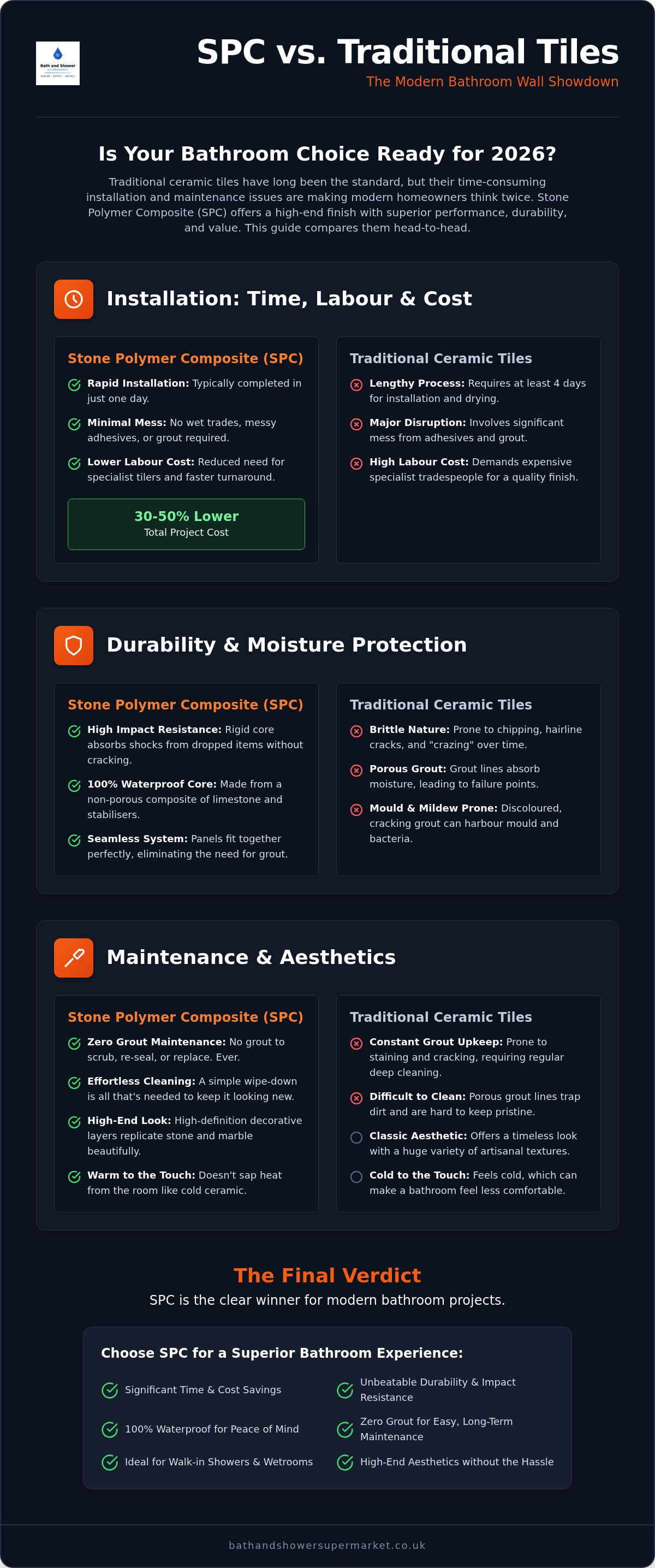
The traditional ceramic tile has long been the "obvious" choice for a luxury bathroom, yet it might actually be the most expensive mistake you make in 2026. Whilst the aesthetic is timeless, the reality of installation often involves high labour costs, messy adhesives, and at least four days of household disruption. When comparing SPC wall tiles vs traditional tiles, it's clear that Stone Polymer Composite is rapidly becoming the smarter, more efficient alternative for the modern British homeowner.
Frustrations like discoloured grout and hairline cracks are common with masonry, but they aren't inevitable. You need a space that's waterproof, easy-to-clean, and resilient. This guide explores how SPC technology provides a high-end stone finish in as little as one day, significantly reducing the labour and disruption associated with traditional tiling. We'll examine the structural benefits, maintenance requirements, and long-term value of these materials to help you make an informed, confident decision for your next project. Discover why this innovative material is the durable, stylish, and reliable solution for the contemporary home.
Key Takeaways
- Understand the significant time savings of Stone Polymer Composite, which can often be installed in a single day without the mess and disruption of traditional adhesives.
- Compare the structural integrity of SPC wall tiles vs traditional tiles to see why composite materials are more resistant to impacts, chips, and moisture.
- Discover how to achieve a high-end marble or stone aesthetic without the long-term maintenance issues of discoloured, porous, or cracked grout lines.
- Learn why the total project cost for SPC is often 30–50% lower than ceramic alternatives due to reduced specialist labour requirements and faster turnaround times.
- Identify the most efficient materials for modern bathroom upgrades, including walk-in shower installations and full wetroom projects.
Understanding the Basics: What is SPC vs Traditional Ceramic?
Selecting the right wall covering involves more than just picking a pattern. It requires an understanding of the material science that dictates how your bathroom will perform over the next decade. When evaluating SPC wall tiles vs traditional tiles, ceramic remains a staple of British homes, manufactured from kiln-fired clay or porcelain to create a hard, glazed surface. Whilst they offer a classic aesthetic, they are often brittle and labour-intensive to install. In contrast, SPC (Stone Polymer Composite) represents a shift toward modern efficiency. It is a dense, rigid, and high-performance material designed to solve the common failures of masonry.
The core difference between these materials lies in their composition and their relationship with moisture. SPC is a form of engineered stone that blends natural limestone powder with advanced stabilisers. This creates a board that is 100% waterproof and remarkably impact-resistant. Unlike ceramic, which relies on porous grout lines to fill gaps, SPC systems are designed to fit together seamlessly. This eliminates the primary point of failure in most bathrooms, providing a surface that is clean, fast, and reliable.
The Anatomy of an SPC Wall Tile
Premium SPC wall tiles utilise a sophisticated multi-layer construction. At the heart of the tile is a solid 4mm core. This provides the structural weight and density of stone without the logistical nightmare of heavy slabs. Above this core sits a high-definition decorative layer, followed by a protective wear layer. This finish is tough, UV-resistant, and incredibly easy to clean. One of the most immediate benefits is the temperature; SPC is naturally warm-to-touch. It doesn't sap heat from the room like cold ceramic, making your morning routine much more comfortable.
Traditional Ceramic and Porcelain: The Heritage Choice
Ceramic and porcelain are the heritage choices for a reason. They provide an enormous variety of sizes, glazes, and artisanal textures. However, this beauty comes with a high level of fragility. Tiles are prone to chipping during transit or cracking during the cutting process. Once on the wall, they rely entirely on cement-based grout for waterproofing. Grout is the weak link in any bathroom installation. It is prone to staining, cracking, and harbouring mould. Whilst traditional tiles offer a familiar look, they demand a level of long-term maintenance that many homeowners find exhausting.
The choice between these materials often comes down to a balance of tradition and technology. When comparing SPC wall tiles vs traditional tiles, SPC delivers the visual impact of stone with a refined, industrial-grade durability that ceramic simply cannot match in a high-traffic environment.
Durability and Performance: Which Tile Wins in 2026?
When comparing SPC wall tiles vs traditional tiles, the most significant performance gap appears in daily wear and tear. Traditional ceramic tiles are notoriously brittle. A dropped perfume bottle or a heavy shower head can easily cause a hairline crack or a visible chip that ruins the entire aesthetic. SPC is engineered for structural resilience. Its dense, rigid core absorbs shock without shattering. Impact resistance is defined as the material's ability to withstand sudden, forceful contact from dropped objects without structural failure. This makes it a superior choice for high-traffic family bathrooms where durability is non-negotiable.
Impact Resistance and Longevity
In a busy Newcastle household, the bathroom is often the most abused room in the house. Ceramic tiles, whilst beautiful, are prone to "crazing" or cracking over time as the house settles. Because SPC wall tiles are rigid rather than brittle, they maintain their integrity even when subjected to the knocks and bumps of a chaotic morning routine. They don't chip, they don't crack, and they don't require the delicate handling that porcelain demands during its lifecycle. This results in a wall covering that looks as good in year ten as it did on day one.
Moisture Protection and Mould Prevention
Moisture protection is where the battle of SPC wall tiles vs traditional tiles is truly won. Traditional tiling relies on cement-based grout. Grout is inherently porous. Over time, it absorbs water, leading to the discolouration and mould growth seen in many older Durham terraces. The Stone Plastic Composite (SPC) composition ensures that the material itself is 100% waterproof. Instead of relying on a secondary sealant, SPC uses a sophisticated tongue-and-groove system. This creates a mechanical seal that prevents water from ever reaching the substrate. It's a practical solution that eliminates the five-to-ten-year cycle of regrouting.
Thermal stability is another critical factor for 2026. Bathrooms experience rapid temperature shifts, from cold mornings to steaming showers. SPC is designed to resist expansion and contraction, ensuring the joints remain tight and waterproof. Additionally, weight is a major consideration for North East UK homes with plasterboard or stud walls. Traditional large-format tiles are exceptionally heavy and can exceed the weight limits of standard wall boards. SPC offers a lightweight alternative that provides the look of heavy marble or stone without the risk of pulling away from the wall or requiring expensive structural reinforcement. If you're planning a full renovation, you can explore our range of SPC bathroom flooring to match your new walls for a completely waterproof room.
Installation Comparison: Time, Labour, and Complexity
The installation phase is where the debate between SPC wall tiles vs traditional tiles becomes a matter of logistical reality. Traditional tiling is a multi-stage, wet process that demands patience and precision. You must manage heavy bags of adhesive, plastic spacers, and cement-based grout. Each stage requires significant drying time, often extending a simple wall covering project into a four-day ordeal. In contrast, SPC installation is a dry, streamlined system that treats the wall like a carpentry project rather than a masonry one. It is fast, clean, and reliable.
Labour costs in the North East reflect this complexity. Professional tilers are amongst the most expensive trades in the region, with high daily rates and limited availability. Because SPC tiles use basic woodworking tools, they are significantly faster to fit. This speed translates directly into lower labour bills. A major advantage of SPC is its ability to be installed directly over existing tiles. This bypasses the dusty, time-consuming demolition phase, allowing for a rapid transformation without the skip hire or the mess. Many homeowners find that a full bathroom installation using SPC can be completed in half the time of a ceramic equivalent.
The Professional Tiler vs DIY SPC Fitting
Achieving a perfect finish with ceramic tiles requires years of experience. One misaligned spacer or uneven adhesive bed can ruin the entire wall. SPC wall tiles are designed with the homeowner in mind. They are lightweight, manageable, and precise. You don't need a wet saw or specialised cutters; many panels can be scored and snapped with a simple craft knife. For those planning a full renovation, our Bathroom Installation Guide provides essential tips for coordinating your project and managing trades effectively.
Subfloor and Wall Preparation Requirements
Traditional tiles are unforgiving. They require a perfectly flat, primed, and stable surface to prevent the grout from cracking later. If your walls are slightly out of true, a tiler must spend hours levelling the substrate with expensive compounds. The inherent rigidity of the SPC core allows it to mask minor wall imperfections. It bridges small gaps and uneven patches that would cause ceramic tiles to fail. This makes it an ideal solution for renovations in Whitley Bay or Alnwick, where older properties often have less-than-perfect walls. You can achieve a high-end look without the extensive remedial work usually required for masonry.
When you consider the 30–50% reduction in total installation costs, the choice becomes clear. Whether you are fitting out a new walk-in shower or updating a cloakroom, the efficiency of SPC provides a professional result without the professional price tag. You can browse our full range of SPC bathroom flooring to find a matching finish that completes your room's waterproof seal.
Design Aesthetics and Maintenance: The Long-Term Reality
Choosing between SPC wall tiles vs traditional tiles often comes down to the balance between artisanal variety and modern performance. Traditional ceramic and porcelain have a long history of offering bespoke finishes, handmade textures, and a vast array of sizes. However, the visual landscape has shifted. Modern SPC technology delivers precision, depth, and realism through high-definition printing. These boards capture the intricate veining of Calacatta marble and the granular depth of natural slate with incredible accuracy, providing a high-end look that is indistinguishable from the real thing.
Achieving the Natural Stone and Marble Look
The most striking difference is the "grid" effect. Traditional tiling creates a visual network of grout lines that can interrupt the flow of a room. SPC panels are designed for a seamless transition, allowing a marble pattern to sweep across a wall without distraction. Many of our premium ranges feature matte and authentic textured finishes that feel like real stone under your fingertips. For a detailed look at how these designs perform in real-world settings, you can read our Scudo Core Collection review. It provides a comprehensive guide to the latest textures available for UK homes.
Cleaning and Hygiene in Hard Water Areas
Maintenance is where the "heritage" choice often fails the modern homeowner. In hard water regions across the North East, limescale build-up is a constant battle. In a traditional bathroom, this mineral deposit clings to porous grout, leading to stubborn discolouration and mould growth. You're often left with no choice but to spend hours scrubbing with harsh chemicals to keep the room looking presentable. This is a repetitive, exhausting, and ultimately futile task as the cycle begins again after the next shower.
SPC removes the weak link entirely. Because there is no grout, there is nowhere for bacteria or limescale to hide. A simple wipe down with soapy water is all that's required to keep the surface pristine. For busy families in areas like Kingston Park or Gosforth, this "wipe-clean" reality is a significant time-saver. It's a hygienic, low-effort, reliable solution that maintains its high-end finish without the need for specialist cleaners or intensive labour. You can achieve a professional result that stays clean with minimal intervention.
If you're ready to upgrade your space with a material that values your time as much as your style, you can view our full range of SPC wall tiles for fast delivery from our Morpeth warehouse.
The Final Verdict: Is SPC Right for Your Bathroom?
Deciding between SPC wall tiles vs traditional tiles is no longer a choice between "cheap" and "expensive". It's a strategic decision based on logistical efficiency and long-term performance. For the modern British homeowner, Stone Polymer Composite provides a superior cost-to-value ratio. When you factor in the 30–50% reduction in total installation costs, SPC isn't just a material choice; it's a way to protect your budget. This efficiency allows you to invest more in high-end finishes, such as Scudo Bathroom Furniture or a Kartell Nero Square LED Black Bathroom Mirror, without compromising on the quality of your wall coverings.
When to Choose SPC Wall Tiles
SPC is the logical choice for those who prioritise a low-maintenance, high-performance bathroom. It is the ideal solution for several specific scenarios:
- Fast Renovations: If you need a functional bathroom in 24 hours rather than a week, the dry installation of SPC is unbeatable.
- Rental Properties: The impact resistance ensures the walls won't chip or crack under heavy use by tenants.
- Family Bathrooms: A grout-free environment is significantly more hygienic and easier to keep pristine amongst the chaos of a busy household.
If you're ready to move away from the frustrations of traditional masonry, we encourage you to browse our curated range of DCD SPC Wall Tiles. These products are held in stock at our Morpeth warehouse, ensuring fast, direct-to-door delivery across the UK.
When to Stick with Traditional Ceramic
Whilst technology has advanced, traditional ceramic and porcelain still have their place. You should consider sticking with traditional tiles if you are renovating a heritage property where period-accurate, artisanal designs are essential. If your project has a larger budget for professional labour and you aren't concerned by a 12–14 day refit timeline, ceramic offers a level of bespoke sizing that composite boards cannot yet match. For those looking for a complete, coordinated look, our Bathroom Packages provide excellent suite options that work beautifully with both traditional and modern wall coverings.
Our final, no-nonsense recommendation is clear. If you value durability, speed, and a grout-free lifestyle, SPC is the superior material for a 2026 bathroom. It solves the structural failures of the past whilst delivering a high-end, stone-effect finish that lasts. Avoid the mess of adhesives and the cost of specialist tilers by choosing a material designed for the way we live today. We are a stable, high-volume specialist, and our team is ready to help you navigate our vast selection to find the perfect fit for your home.
Secure a Smarter, Faster Bathroom Transformation
The shift in the UK market is decisive. When comparing SPC wall tiles vs traditional tiles, the advantages of Stone Polymer Composite are clear. It offers faster installation, superior impact resistance, and a grout-free finish that eliminates mould. You don't have to choose between a high-end stone aesthetic and practical durability. SPC delivers both whilst significantly reducing the disruption to your home life.
As an authorised Scudo UK retailer, we maintain over 3,000 products in stock to ensure your project stays on schedule. Everything is dispatched with fast delivery from our Morpeth warehouse. Our solutions are practical, durable, and refined. For those living in the North East, we also offer professional installation services to guarantee a flawless result. It's time to build a bathroom that values your time and provides lasting peace of mind.
Shop our full range of DCD SPC Wall Tiles for your next project and start your renovation today. Your ideal, low-maintenance bathroom is closer than you think.
Frequently Asked Questions
Is SPC wall tiling cheaper than traditional ceramic tiling?
Yes, the total installed cost is typically 30–50% less than ceramic alternatives. While material prices vary, you save significantly on specialist labour and sundries. Traditional tiling requires expensive adhesives, spacers, and grout, alongside several days of professional trade rates. SPC installs in about a day, making it a far more efficient use of your renovation budget without compromising on the final high-end aesthetic.
Can I install SPC wall tiles directly over my old ceramic tiles?
You can install these panels directly over existing tiles if the surface is clean, dry, and structurally sound. This "tile-over-tile" method is a major advantage for modern renovations. It eliminates the need for dusty demolition, skip hire, and intensive wall repairs. The rigid core of the SPC boards bridges minor grout line indentations, ensuring a flat and professional finish with minimal preparation work required.
Do SPC wall tiles look like real stone or marble?
Modern printing technology ensures that these panels are indistinguishable from natural materials. When evaluating SPC wall tiles vs traditional tiles, the visual gap has closed entirely. These tiles feature high-definition patterns that capture the intricate veining of marble or the granular depth of slate. Because they lack grout lines, they often provide a more seamless and authentic stone look than a traditional tiled grid.
How long do SPC wall tiles last compared to ceramic?
SPC panels generally have a functional lifespan of 15–25 years. While ceramic tiles can last longer, their grout lines often fail or discolour within five to ten years. SPC is more impact-resistant and will not chip or crack if struck by heavy objects. In a high-traffic family bathroom, the structural integrity of the Stone Polymer Composite core often provides better long-term reliability than brittle masonry surfaces.
Are SPC wall tiles suitable for use inside a shower enclosure?
These tiles are 100% waterproof and specifically engineered for high-moisture environments. The tongue-and-groove locking system creates a mechanical seal that prevents water ingress behind the panels. Unlike traditional tiles, there is no porous grout to harbour mould or allow leaks over time. This makes them a dependable choice for walk-in shower installations where long-term moisture protection and hygiene are the primary concerns for the homeowner.
What tools do I need to fit SPC wall tiles myself?
You only need basic woodworking tools to complete the installation. A simple craft knife is often sufficient to score and snap the panels to size. You will also require a tape measure, a spirit level, and a high-quality adhesive. You don't need wet saws, nippers, or specialised mixing equipment. This makes it an accessible DIY project that avoids the complexity and mess associated with traditional masonry work.
How do I clean SPC wall tiles without damaging the surface?
Cleaning is straightforward and only requires warm soapy water and a soft cloth. You should avoid abrasive scrubbers or harsh, bleach-based chemicals that could dull the protective wear layer. Because the surface is non-porous and lacks grout, dirt and limescale have nowhere to hide. This "wipe-clean" efficiency is a significant benefit for homeowners in hard water areas who want to maintain a pristine bathroom with minimal effort.
Is SPC wall flooring the same as the wall tiles?
No, although they share the same core technology, they are engineered for different purposes. Wall tiles are typically thinner and lighter to reduce the load on your plasterboard. In contrast, SPC bathroom flooring is thicker and features a more robust wear layer to handle foot traffic. Whilst they can be matched aesthetically, it is important to use the specific product designed for each surface to ensure longevity.


