

What if the most resilient surface in your bathroom required zero maintenance and absolutely no grout? It's a common frustration for homeowners across the UK. You've likely spent hours scrubbing mouldy grout lines or faced the significant mess and expense of traditional professional tiling. You're probably asking: are SPC wall panels any good? We understand the demand for a solution that's rigid, waterproof, and enduring.
In this guide, you'll discover the truth about Stone Plastic Composite technology. We'll explain how these panels provide a high-end stone aesthetic without the structural weight or the logistical delays of ceramic alternatives. You'll learn the critical differences between flimsy, hollow PVC and professional-grade SPC, ensuring you make an informed investment for your 2026 renovation. We'll cover fire safety standards, installation speed, and why this stone-core material is now the definitive choice for modern British bathrooms.
Key Takeaways
- Understand the technical engineering of Stone Plastic Composite and why its limestone core provides superior rigidity and impact resistance over standard PVC alternatives.
- Determine the long-term durability of these surfaces to answer are SPC wall panels any good for demanding, high-moisture UK bathroom environments.
- Learn how the grout-free, interlocking system eliminates mould sites and drastically reduces the weekly maintenance required for a hygienic shower area.
- Discover the logistical advantages of over-boarding existing tiles, which allows for a fast, clean, and professional installation without the mess of demolition.
- Calculate the total project value by comparing the initial cost of premium panels against the significant labour savings and 20-year lifespan they offer.
Debunking the 'Plastic' Myth: What Exactly Are SPC Wall Panels?
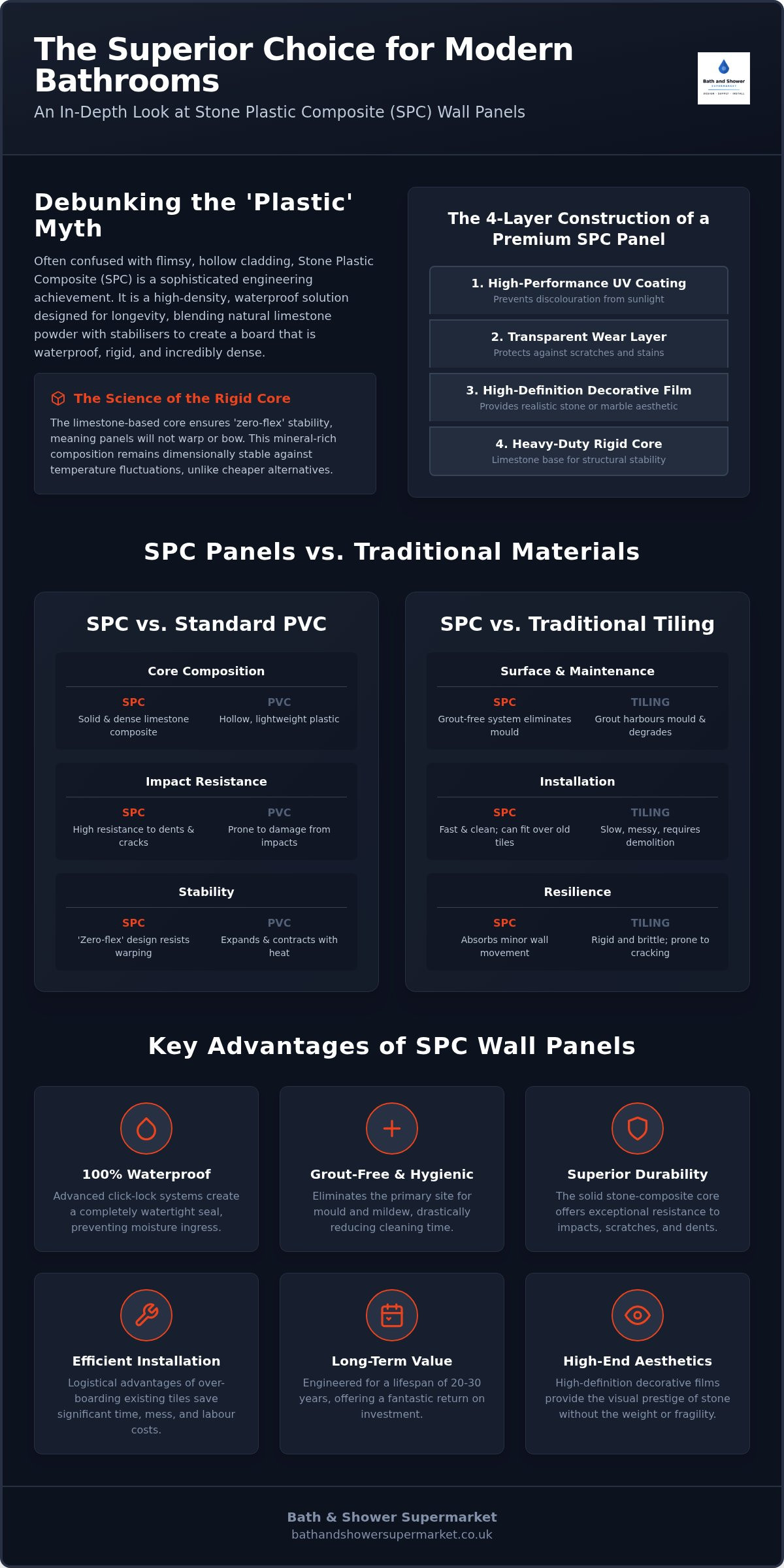
The term 'plastic' often carries a stigma of flimsiness and cheap aesthetics, yet modern Stone Plastic Composite (SPC) panels represent a complete departure from this perception. Many homeowners asking are SPC wall panels any good often confuse them with the thin, hollow cladding found in discount outlets. In reality, SPC is a sophisticated engineering achievement. To understand the material, we must look at What Are Composite Materials? by definition; they are a blend of two or more constituent materials that, when combined, produce qualities superior to the individual parts. In this case, SPC blends natural limestone powder with stabilisers to create a board that is waterproof, rigid, and incredibly dense.
The construction of a premium SPC panel involves a meticulous four-layer system. A high-performance UV coating sits at the top to prevent discolouration from sunlight. Beneath this lies a transparent wear layer that protects against scratches and stains. The third layer is the high-definition decorative film, which provides the realistic stone or marble aesthetic. Finally, the heavy-duty rigid core provides the structural heart of the panel. This layered approach is why 2026 homeowners are moving away from ceramic tiles. They want the visual prestige of stone without the weight, the fragility, or the inevitable decay of grout lines.
The Science of the Rigid Core
The defining feature of SPC is its limestone-base core. This mineral-rich composition ensures the panels have 'zero-flex' stability, meaning they won't warp or bow even when installed over slightly uneven surfaces. This density is particularly vital for UK bathrooms that utilise underfloor heating or experience significant temperature fluctuations. Whilst cheaper materials expand and contract, leading to joint failure, SPC remains dimensionally stable. Simply put, SPC is a high-density, waterproof stone-composite solution designed for longevity.
SPC vs. PVC: Why Material Quality Matters
The difference between standard PVC and SPC is immediately apparent upon contact. Traditional PVC panels are hollow and lightweight, often producing a noticeable 'bounce' or hollow sound when tapped. SPC panels are solid and heavy, providing a tactile experience that mimics real tile or stone. This density translates directly into impact resistance. An SPC surface will not dent or crack if a heavy shower head is dropped against it, a common failing of both ceramic tiles and hollow cladding. For those seeking a professional finish, our specialist installation support ensures these high-definition, textured surfaces are fitted with the precision they deserve. The result is a bathroom that looks and feels like a luxury stone installation but functions with the efficiency of modern composite technology.
Rigidity and Resilience: Why SPC Outlasts Traditional Tiles
Tiling is frequently viewed as the gold standard for bathroom longevity, but this perspective often ignores the vulnerability of the installation as a whole. Whilst a porcelain tile might last decades, the cementitious grout between them rarely does. This is the point where many homeowners ask are SPC wall panels any good in comparison to traditional methods. High-quality SPC panels are engineered for a lifespan of 20 to 30 years, often outlasting the waterproof integrity of a tiled room. Unlike rigid ceramic, the stone-composite core possesses a subtle resilience that allows it to absorb minor structural movements without cracking. This makes them particularly suitable for UK homes where seasonal shifts can cause slight wall movement.
The technical resilience of these surfaces is rooted in their mineral-heavy composition. When researching What Are SPC Wall Panels? you will find they utilise a blend of high-density calcium powder and thermoplastic polymers. This specific combination creates a surface that is UV-stable and resistant to discolouration. You won't experience the yellowing or fading associated with older, cheaper plastic alternatives. The finish remains crisp and authentic for the duration of its life, providing a reliable, stable, and professional aesthetic that doesn't degrade under the harsh conditions of a steamy bathroom.
Waterproofing and Moisture Protection
Shower enclosures and wetrooms demand absolute water integrity to prevent structural rot. The advanced click-lock system on modern panels creates a 100% watertight seal that prevents moisture ingress into the wall substrate. This level of protection is vital for high-humidity environments where steam can penetrate even the smallest gaps. If you're planning a complete overhaul, it's worth exploring our SPC bathroom flooring to achieve the same level of protection across your entire room. You should also consult our guide on the Best Waterproof Bathroom Flooring: 2026 UK Expert Guide to ensure your subfloor is equally secure.
Hygiene and Maintenance Reality
The most immediate lifestyle benefit for the homeowner is the total elimination of grout maintenance. Grout is inherently porous, acting as a primary site for bacteria, soap scum, and black mould growth. Large-format SPC panels remove these failure points entirely. The result is a surface that is hygienic, durable, and effortless. These panels resist common household chemicals and prevent the stubborn limescale buildup that often plagues textured tiles. Maintenance involves nothing more than a quick wipe with a damp cloth to keep the surface looking pristine. For those seeking a long-term solution, investing in high-quality SPC wall tiles ensures your bathroom remains a low-maintenance, high-performance space for years to come.
The Installation Myth: Is Fitting SPC Panels a DIY Disaster?
A common misconception suggests that large-format panels are more difficult to handle than traditional tiles. This is simply not the case. When homeowners ask are SPC wall panels any good for a quick renovation, the answer lies in the logistical efficiency of the material. A standard tiling job often requires three days of labour, including surface preparation, setting, and grouting. In contrast, an SPC installation can frequently be completed in a single day. This process is fast, clean, and professional. This efficiency stems from the material's rigid core. Because the boards are dimensionally stable, they don't require the same level of delicate handling as ceramic. You can find more technical details on Why SPC Outlasts Traditional Tiles through its core stability.
One of the most significant advantages is the 'over-tile' capability. If your existing tiles are sound and level, SPC panels can be fitted directly over them. This removes the need for messy, time-consuming demolition. It saves on skip hire. It eliminates dust. It accelerates the entire project timeline. For a precision finish, you'll need standard wood-cutting tools, a high-bond waterproof grab adhesive, and a steady hand for scribing. The result is a high-end look without the structural upheaval typically associated with bathroom remodelling.
Step-by-Step Installation Overview
Successful fitting relies on three core stages. First, surface preparation is paramount. Walls must be flat, dry, and free of loose debris. Any significant dips should be filled to ensure the adhesive makes full contact. Second, cutting and scribing require accuracy. Because of the limestone core, a fine-toothed hand saw or a circular saw provides the cleanest edge. SPC is dense but easy to work with using standard carpentry equipment. Third, adhesive and sealing. A high-quality, solvent-free grab adhesive ensures a permanent bond. Applying a continuous bead of specialist sanitary silicone to the tongue-and-groove joints creates a barrier that is robust, permanent, and invisible.
Why Professional Installation Trumps DIY
Whilst the process is straightforward, the detail is in the finishing. Expert corner-jointing and the correct application of finishing trims make the difference between a functional room and a high-end showroom look. Precision is required when cutting around pipework or shower valves to maintain the waterproof envelope. Professional fitting also ensures that your product warranty remains intact. Manufacturers often require proof of correct installation to honour long-term claims. If you're still wondering are SPC wall panels any good for your specific layout, our Professional Bathroom Installation Services provide the expertise needed for a flawless finish. It's the most reliable way to ensure your investment remains precise, durable, and watertight.
Value vs. Cost: Are SPC Panels a Worthwhile Investment?
When calculating a bathroom budget, the upfront price of materials is only one part of the equation. Many homeowners wonder are SPC wall panels any good when they see that premium stone-composite boards can cost as much as high-end porcelain tiles. However, focusing solely on the purchase price ignores the substantial savings found in the installation and maintenance phases. SPC panels represent a strategic investment. They are durable, efficient, and cost-effective.
A significant portion of any tiling quote is the labour. Tiling is a multi-stage process involving priming, setting, spacing, and grouting, which typically spans three to four days for a standard UK bathroom. Because SPC panels utilise a large-format click system, a professional can often complete the same area in a single day. This 75% reduction in labour time directly lowers your final bill. You also save on auxiliary materials. There is no need for bags of grout, plastic spacers, or the specialized sealants required for porous stone.
The Total Cost of Ownership
The financial benefits of SPC extend far beyond the initial fitting. Over a ten-year period, the total cost of owning an SPC surface is significantly lower than a tiled equivalent. You aren't just buying a wall covering; you're buying a decade of maintenance-free performance. Consider these factors:
- Reduced material waste: Large panels mean fewer offcuts compared to small tiles.
- Minimal auxiliary costs: No need for grout or expensive tile adhesives.
- Long-term maintenance: You eliminate the cost of professional regrouting or mould treatments every five years.
Aesthetic ROI: Achieving the High-End Look
Achieving a seamless marble or slate finish with real stone requires specialist masonry and reinforced walls to handle the weight. SPC panels provide these luxury aesthetics without the structural requirements or the prohibitive price tag. Unlike ceramic tiles, which can suffer from batch variation where different boxes show slight shade shifts, SPC panels offer total consistency across your entire order. This ensures a uniform, professional finish that enhances the overall value of your property.
Our range of Scudo SPC wall tiles combines these premium aesthetics with industrial-grade strength. These products are designed to increase property appeal by providing a modern, clean, and high-specification finish that resonates with contemporary buyers. To ensure your investment is fitted to the highest standards, explore our professional installation support to guarantee a precision finish for your 2026 renovation.
The Verdict: Choosing Your SPC Panels for 2026
The evidence is conclusive. For homeowners asking are SPC wall panels any good, the answer is found in the material's consistent performance. These panels are waterproof, rigid, and aesthetically superior. They solve the primary failings of traditional bathrooms by removing grout and providing a surface that resists impact and moisture. As we look toward 2026, the shift from ceramic tiles to stone-composite technology is accelerating across the UK. This transition is driven by a need for longevity and a desire for cleaner, more efficient living spaces.
When selecting your panels, pay close attention to the technical specifications. A thickness of 4mm to 6mm is standard for wall applications, providing the necessary rigidity without excessive weight. Ensure your chosen product features a high-performance wear layer and a UV-stable coating to protect against daily wear and sunlight. Brands like Kartell and Scudo have set the UK gold standard, offering industrial-grade durability paired with high-definition finishes that mimic natural stone with startling accuracy. These manufacturers provide the peace of mind that comes from verified quality and structural integrity.
Which Style Suits Your Bathroom?
Your choice between large-format panels and SPC wall tiles depends on your design goals. Large-format panels are ideal for creating seamless shower enclosures with no visible joints. They offer a clean, expansive look that works well with marble and concrete textures. Conversely, SPC wall tiles provide the classic aesthetic of traditional tiling but with the modern benefits of a stone-composite core. For a cohesive room design, consider matching your wall surfaces with Scudo Bathroom Furniture. This ensures your cabinetry and wall finishes complement each other in both quality and style, creating a unified professional finish.
Ready to Renovate?
Bath & Shower Supermarket is established as the UK's trusted SPC supplier. We don't just provide materials; we offer a comprehensive solution for modern renovations. Our supply and installation model removes the stress of coordinating multiple trades. We ensure that your premium Scudo or Kartell products are fitted with the precision they require. This end-to-end service guarantees that your bathroom remains watertight, hygienic, and visually stunning for years to come. If you are ready to upgrade your space, contact us for a professional SPC installation quote today. Our experts are ready to help you achieve a maintenance-free bathroom with a precision finish.
Secure Your Bathroom’s Future with SPC
Transitioning from traditional tiles to Stone Plastic Composite represents a significant upgrade in both bathroom hygiene and structural durability. By removing the need for porous grout, you eliminate the primary cause of mould and moisture ingress. As we've explored, these panels provide a stone-core stability that far exceeds the performance of standard PVC cladding. When determining if are SPC wall panels any good for your 2026 renovation, the answer is found in the material's long-term resilience and the substantial savings in professional labour costs.
Bath & Shower Supermarket is an Authorised UK Retailer for Scudo and Kartell, providing expert logistics from our UK warehouse. We offer a professional installation service to ensure your new surfaces are fitted with technical precision. Our team is ready to help you achieve a high-end finish that is durable, waterproof, and effortless to maintain. Take the next step in your home improvement journey today. Book Your Professional SPC Panel Installation Today and enjoy the peace of mind that comes from a grout-free, expert finish.
Frequently Asked Questions
Are SPC wall panels 100% waterproof?
Yes, the stone-plastic composite core is entirely non-porous and impervious to water. Unlike wood-based laminates or hollow PVC panels, SPC won't swell, rot, or delaminate when exposed to constant moisture. This technical resilience makes them an ideal choice for high-humidity environments like shower enclosures. They provide a reliable, permanent, and watertight surface that protects your bathroom walls for decades.
Can you install SPC wall panels over existing tiles?
Yes, you can fit SPC panels directly over existing stable tiles if the surface is flat and clean. This "over-boarding" method saves significant time and eliminates the mess and cost of demolition. It is a clean, efficient, and professional solution for rapid bathroom renovations. Ensuring the substrate is secure is the only requirement for a successful, long-lasting installation.
Do SPC wall panels expand or contract with heat?
SPC panels are dimensionally stable and exhibit minimal expansion or contraction compared to standard PVC. The high-density limestone core ensures they remain rigid in the fluctuating temperatures of a typical UK bathroom. They are compatible with underfloor heating and high-output shower systems without warping or bowing. This stability prevents joint failure and ensures the waterproof seal remains intact throughout the year.
How do you clean SPC bathroom panels without damaging them?
Cleaning requires only warm soapy water and a soft cloth or sponge. You must avoid abrasive chemicals, bleach, or scouring pads that could scratch the protective wear layer. Because these panels are grout-free, dirt and limescale have no porous surface to bond with. This makes the maintenance process fast, hygienic, and effortless, keeping your bathroom looking pristine with minimal labour.
Are SPC wall panels better than PVC panels?
Yes, SPC panels offer superior durability, rigidity, and impact resistance compared to hollow-core PVC. When homeowners ask are SPC wall panels any good, the comparison to PVC is essential. SPC feels like solid stone or tile, whereas PVC often feels thin and flexible. This increased density means SPC won't dent or crack easily, providing a more professional and premium finish.
Can I use SPC wall panels in a walk-in shower?
Absolutely, SPC panels are specifically engineered for wet areas like walk-in showers and wetrooms. Their interlocking tongue-and-groove system, when combined with a high-quality sanitary silicone, creates a robust and watertight barrier. They provide a high-end, seamless aesthetic that stands up to daily water exposure. This makes them a more reliable and lower-maintenance alternative to traditional tiles and grout.
Do SPC panels require specialist cutting tools?
No, you don't need specialist masonry equipment to work with SPC. You can cut these panels using standard woodworking tools like a fine-toothed hand saw, jigsaw, or a circular saw. Despite their dense limestone core, they are easy to scribe and trim for a precision fit around pipes and valves. This simplicity accelerates the installation process and reduces the overall project timeline.
How long do SPC bathroom panels last?
High-quality SPC bathroom panels have a projected lifespan of 20 to 30 years. Their structural integrity often outlasts traditional tiles because they lack the grout lines that inevitably fail and leak over time. For those questioning are SPC wall panels any good, this long-term durability provides exceptional value. They offer a permanent, low-maintenance solution that remains visually and technically sound for decades.


