

Most UK homeowners still fear that the intense heat of modern systems will cause their luxury vinyl to buckle, warp, or fail. It is a valid concern; nobody wants to invest thousands in a renovation only to find cold spots or lifting planks six months later. However, selecting the correct material ensures your investment remains protected. Discover how to perfectly integrate underfloor heating with SPC flooring to create a bathroom environment that is warm, waterproof, and resilient.
You deserve a floor that offers precision, stability, and comfort. This guide explores the technical compatibility of electric and water-based systems whilst addressing the strict 27°C temperature limits required for Scudo SPC products. We will navigate the complexities of subfloor moisture levels and the 2022 Part L Building Regulations to ensure your project is efficient, compliant, and permanent. By the end, you will have the confidence to choose a professional, managed installation route that eliminates DIY errors and secures your home's long-term value. This comprehensive approach provides the peace of mind that comes from technical expertise and logistical reliability.
Key Takeaways
- Learn why the limestone-core construction of SPC provides superior thermal stability and heat conductivity compared to traditional luxury vinyl alternatives.
- Understand the critical technical parameters for underfloor heating with SPC flooring, including the 27°C surface temperature limit and optimal R-values for efficiency.
- Discover the benefits of a managed installation service that bridges the gap between high-quality product supply and precise technical execution.
- Identify the correct maintenance protocols for heated floors in wet environments to preserve the 100% waterproof integrity of your bathroom.
- Gain professional insights into selecting the ideal plank thickness and wear layer to ensure rapid heat transfer and long-term structural durability.
Understanding Underfloor Heating with SPC Flooring in Modern Bathrooms
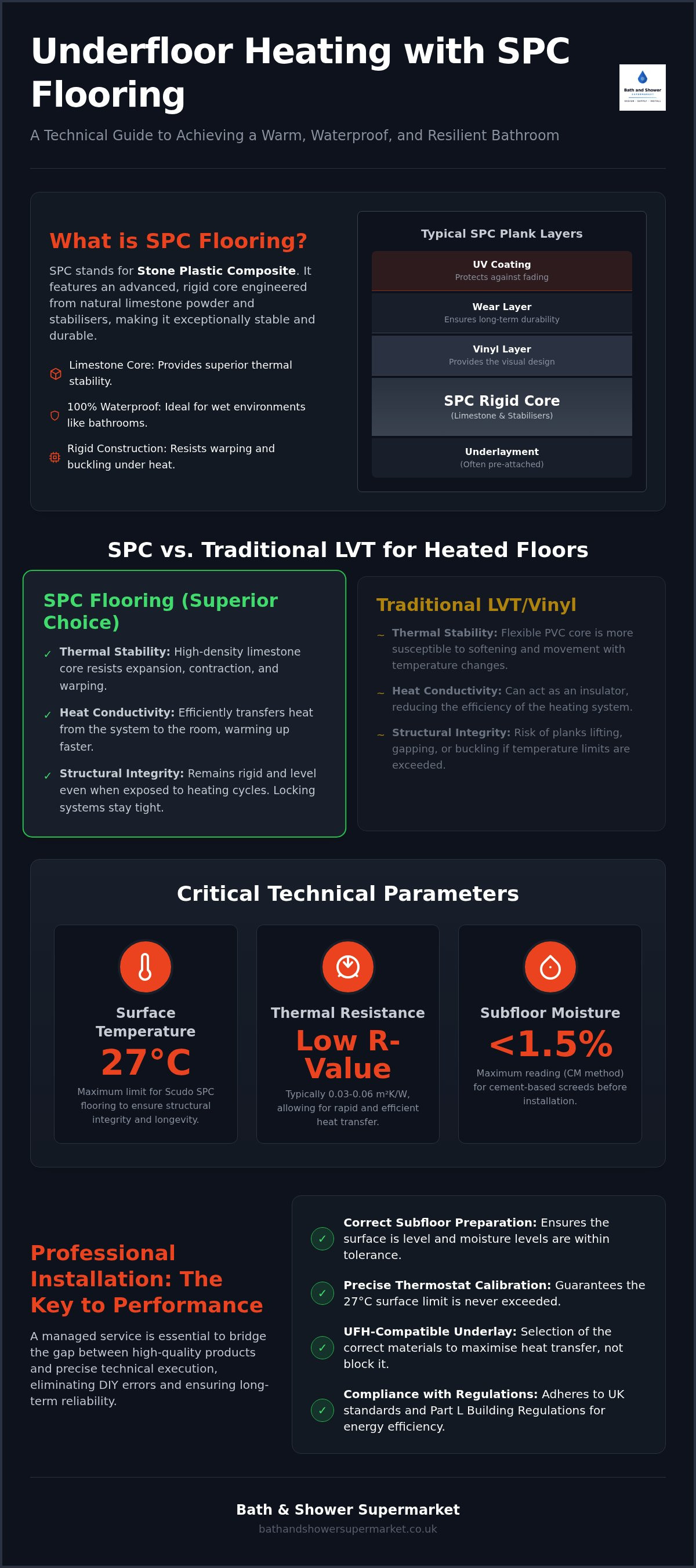
SPC stands for Stone Plastic Composite. It is an advanced flooring solution engineered with a core of natural limestone powder and stabilisers. This rigid core distinguishes it from traditional luxury vinyl tiles (LVT) which rely on flexible PVC. When integrating underfloor heating with SPC flooring, this structural density becomes a primary advantage. It provides a surface that is durable, stable, and resilient. It acts as the ideal medium for heat transfer, bridging the gap between the efficiency of stone and the comfort of vinyl.
Why SPC is the Superior Choice for Heated Floors
SPC is specifically designed to handle temperature fluctuations without the risk of significant expansion or contraction. The high density of the limestone core ensures superior heat retention and efficient thermal conductivity. Unlike laminate or real wood, SPC does not warp when exposed to humidity or direct heat from below. The advanced click locking system remains tight; it accommodates the subtle thermal movements that occur during heating cycles. Standard vinyl often softens under heat, but the stone-core remains rigid. This ensures your bathroom floor stays level, uniform, and structurally sound over decades of use.
The Benefits of a Warm, Waterproof Bathroom
Underfloor heating systems have transitioned from a luxury addition to a practical necessity in modern UK homes. Stepping onto a cold tile during a British winter is unpleasant; SPC solves this by conducting heat quickly to the surface. Because SPC is 100% waterproof, it is the perfect partner for wet environments. The warmth also aids in drying out spills and surface moisture faster, reducing the risk of slips and mould growth. To achieve a seamless look, many homeowners combine this with SPC bathroom flooring on the walls for a fully coordinated, high-performance finish. It creates a space that is functional, aesthetic, and exceptionally comfortable.
Success depends on the synergy between product quality and technical execution. We provide high-specification SPC planks designed for thermal compatibility, but the installation must be precise. Subfloor preparation and thermostat calibration are critical to prevent hot spots that exceed the manufacturer's recommended limits. Professional fitters ensure that the subfloor moisture levels are within the required 1.5% CM for cement-based screeds before any heating elements are laid. Our managed installation service ensures that every component is fitted to professional standards, guaranteeing a floor that performs as expected for years. This end-to-end approach removes the risk of DIY failure and ensures your bathroom meets the latest energy efficiency standards.
Key Technical Requirements for SPC Flooring and Underfloor Heating
Successful integration of underfloor heating with SPC flooring requires strict adherence to technical parameters. The most critical factor is the surface temperature limit. For Scudo SPC flooring, the maximum recommended temperature is 27°C. Exceeding this threshold risks compromising the material's structural integrity or causing the top wear layer to degrade prematurely. Modern thermostats must be correctly calibrated to ensure this limit is never breached, providing a safe, efficient, and consistent heat source.
Thermal resistance, measured as the R-value, determines how effectively heat moves through the floor. SPC flooring typically offers a low R-value between 0.03 and 0.06 m²K/W. This ensures rapid heat transfer whilst maintaining the floor's durability. To achieve these performance levels, you must use a specific UFH-compatible underlay. Standard underlays often act as insulators; they block the heat and force the system to work harder. A professional installer will verify that the combined R-value of the floor and underlay meets UK underfloor heating standards for maximum efficiency. This ensures the system is precise, compliant, and durable.
Electric vs Water-Based Systems
Wet systems use a network of pipes and are typically preferred for new builds or ground-floor extensions. They offer lower running costs and pair effectively with heat pumps. Conversely, electric mats are the standard choice for retrofitting in UK bathrooms due to their slim profile and ease of installation. Regardless of the system type, the heat must be distributed evenly. Uneven heating creates hot spots that can stress the SPC planks. Selecting a high-quality system ensures the thermal load is spread across the entire surface area. It keeps the floor stable, waterproof, and efficient.
Thermal Stability and Expansion Gaps
While SPC is exceptionally stable due to its limestone core, it is not entirely static. It still requires a 5-10mm expansion gap around the perimeter of the room. This gap is hidden by skirting boards or scotia; it allows the floor to breathe as temperatures fluctuate. Professional installers calculate the exact gap required based on the room's dimensions and the anticipated temperature range. Subfloor moisture levels must also be verified before installation begins. For cement-based screeds, levels should be ≤ 1.50% CM to prevent trapped moisture from affecting the heating elements. If you are unsure about the technical setup, our managed installation service provides the expertise needed to handle these calculations and subfloor assessments with precision.
Professional Installation: Why a Managed Service is Essential
Achieving a high-performance finish with underfloor heating with SPC flooring depends entirely on technical precision. Whilst the materials are engineered for durability, the execution determines the system's lifespan. We don't just supply the components; we manage the entire renovation through a coordinated network of specialists who understand the unique requirements of stone-core materials. This single-source approach eliminates the friction between material procurement and physical implementation. It provides a seamless transition from showroom selection to a finished, heated bathroom, giving you total peace of mind.
The Managed Installation Process
Our managed installation process follows a meticulous protocol designed for longevity. First, technical subfloor preparation ensures the surface is level and meets the moisture requirements for SPC. Any deviation here leads to "bouncing" planks or click-system failure. Second, expert laying of the UFH system requires strategic sensor placement and specific cable spacing. This prevents air pockets that cause cold spots or system burnout. Finally, precision fitting of the SPC planks must account for the specific expansion gaps required by the room's perimeter. Learn more about our professional installation services to see how we manage these complexities for you.
Warranty Protection and Longevity
Choosing a professional route is the most effective way to protect your investment. Most manufacturer warranties for Scudo products are conditional on professional installation. DIY errors, such as trapped air or incorrect sensor placement, often void these protections immediately. Installers follow the technical specifications for SPC flooring to ensure the rigid core remains stable under thermal load. This adherence to industry standards prevents the common pitfalls of amateur setups, such as lifting edges or compromised waterproof seals.
Longevity also relies on the "commissioning" phase. Once the floor is laid, the heat must be introduced gradually to avoid thermal shock. A qualified professional will increase the temperature by no more than 5°C per day. This controlled ramp-up allows the materials to settle without stress. This level of meticulous care ensures a floor that is warm, waterproof, and structurally sound for decades. It's the difference between a temporary fix and a permanent home improvement. By trusting a local, expert provider, you ensure your bathroom meets all UK safety and efficiency standards without the stress of managing multiple contractors.
Durability and Maintenance of Heated SPC Floors in Wet Environments
SPC flooring is 100% waterproof. This attribute remains the primary reason for its dominance in modern UK bathroom renovations. Unlike laminate, which swells when exposed to moisture, or natural wood, which can rot, SPC maintains its structural integrity in high-humidity zones. When you integrate underfloor heating with SPC flooring, the material's performance actually improves. The limestone core provides a stable, rigid, and dense foundation that resists the warping often seen in cheaper vinyl alternatives.
Comparing SPC to traditional tiles reveals significant durability advantages. Ceramic and porcelain are brittle; they frequently crack if the subfloor experiences minor movement or if the underfloor heating is commissioned too aggressively. SPC is resilient. It offers a subtle flexibility that absorbs these stresses without fracturing. This makes it a robust, reliable, and long-lasting solution for busy households. It provides a surface that is tough, warm, and virtually indestructible under normal domestic conditions.
There is a persistent myth that heated floors become more slippery when wet. In reality, the opposite is true. Underfloor heating improves safety in bathrooms and wetrooms by accelerating the evaporation of surface water. Splashes from the bath or shower dry significantly faster on a warm surface than on cold tiles. This reduces the time the floor remains slick, effectively lowering the risk of slips and falls. It creates a safer environment whilst maintaining a premium feel.
Cleaning Your Heated SPC Floor
Maintenance is straightforward but requires specific protocols to protect the wear layer. You should always use pH-neutral cleaners to preserve the floor's finish. Avoid harsh chemicals, bleach, or abrasive scouring pads. It's best to turn off the heating system before deep cleaning. This prevents the cleaning solution from drying too rapidly, which can leave streaks or a dull residue on the surface. Because SPC has no grout lines, it is naturally more hygienic than tile. There is no porous material for mould or bacteria to inhabit.
You must never use steam cleaners on SPC flooring. The combination of intense heat and high-pressure steam can force moisture into the click-locking joints or compromise the protective top layer. A simple damp mop is all that is required. This ensures your floor remains clean, efficient, and pristine without the need for specialised equipment.
Pairing with SPC Wall Panels
To achieve the ultimate low-maintenance bathroom, consider creating a fully waterproof "envelope". Pairing your floor with SPC wall panels creates a seamless, grout-free environment that is exceptionally easy to clean. This combination offers a coordinated aesthetic and total moisture protection for your walls and floors alike. You can read our expert guide on whether SPC wall panels are any good to see how they complement a heated floor system. If you are ready to begin your project, view our latest SPC bathroom flooring collections to find the right finish for your home.
Selecting the Ideal SPC Flooring and Heating Solution for Your Project
Selecting the correct specification for underfloor heating with SPC flooring ensures long-term performance and efficiency. You must consider three primary factors: thickness, wear layer, and core density. Planks typically range from 4mm to 8mm in thickness. Thinner planks offer lower thermal resistance; they allow heat to reach the surface quickly. However, thicker planks provide a more substantial, premium, and solid feel underfoot. A wear layer of 0.5mm or higher is recommended for bathrooms to withstand daily moisture and traffic. High core density remains essential; it provides the structural stability needed to withstand the constant thermal cycling of your heating system.
Heat output is equally important. You must choose a system with the correct BTU (British Thermal Unit) rating for your bathroom's dimensions. Bathrooms often have high heat loss due to external walls or large windows. A professional assessment ensures your system is powerful, efficient, and responsive. We recommend premium brands like Scudo for their rigorous testing and proven compatibility with modern heating technology. They offer a range of styles that combine aesthetic appeal with industrial-grade engineering. This ensures your investment is protected by reliable, verified, and high-quality components.
Choosing the Right Aesthetic
Your choice between wood-effect and stone-effect SPC influences the room's atmosphere. Wood-effect planks provide a natural, organic, and warm appearance that softens the clinical feel of a bathroom. Stone-effect tiles offer a sleek, modern, and architectural look. Colour choice also plays a role in the "perceived" warmth; darker tones often feel more cosy whilst lighter shades maximise the sense of space. To create a unified design, many homeowners match their flooring with Scudo bathroom furniture. This ensures a consistent finish across your vanity units, storage, and floor.
Next Steps for Your Bathroom Renovation
The first step is to measure your space accurately and calculate the total coverage required. Don't forget to account for the 10% wastage common in floor fitting. Once you have your dimensions, contact our team for a comprehensive supply and installation quote. We manage the logistics, the technical setup, and the final implementation through our dedicated installation network. You can visit our warehouse to see the materials in person or shop online for fast UK-wide delivery. This end-to-end service ensures your renovation is handled with the professionalism and precision your home deserves. Consolidating your purchase and installation through a single provider reduces risk and guarantees a high-quality result.
Secure Your Modern Bathroom Renovation
Integrating underfloor heating with SPC flooring provides a unique combination of thermal efficiency and total waterproof protection. By adhering to the critical 27°C temperature limit and selecting a high-density limestone core, you ensure a stable foundation that resists warping, shifting, and moisture damage. Success depends on technical precision; from subfloor moisture checks to the gradual commissioning of heat, every detail matters for the long-term durability of your home. This approach guarantees a bathroom that is functional, aesthetic, and exceptionally resilient.
As an authorised UK retailer for Scudo and Kartell, we provide the industrial-grade materials and technical expertise required for a flawless finish. Our specialist SPC flooring stock is backed by a comprehensive managed installation network to remove the stress of DIY errors and warranty concerns. Book your professional bathroom installation today to secure a comprehensive, "done-for-you" solution that delivers immediate comfort and lasting value. Your ideal, warm bathroom is well within reach and ready for the years ahead.
Frequently Asked Questions
Can I use any type of underfloor heating with SPC flooring?
Yes, SPC is technically compatible with both electric and water-based (hydronic) systems. The system must be designed to distribute heat evenly across the entire surface to avoid localised hot spots. Electric mats are the standard choice for UK bathroom retrofits whilst water-based systems are often preferred for new builds. You must ensure the system includes a floor sensor and a calibrated thermostat to regulate the output effectively.
What is the maximum temperature for underfloor heating with SPC?
The surface temperature of your floor should never exceed 27°C. This is a critical industry standard for vinyl-based products, including Scudo SPC flooring. Modern thermostats must be set to this limit to prevent the material from overheating. Exceeding this threshold risks damaging the wear layer or affecting the limestone core's stability. Always verify the specific manufacturer's guidelines before you commission your heating system for the first time.
Do I need a special underlay for SPC flooring with underfloor heating?
Yes, you must use a high-density, low-thermal-resistance underlay specifically designed for heating systems. Traditional underlays often act as insulators; they block the heat and force the system to work harder. A compatible underlay will have a low R-value, typically between 0.03 and 0.06 m²K/W. Many of our SPC planks come with an integrated underlay that is already optimised for thermal conductivity and moisture resistance.
Will underfloor heating cause my SPC flooring to warp or gap?
No, provided the installation follows professional standards and temperature limits. The limestone core of SPC provides exceptional dimensional stability compared to standard luxury vinyl. It expands and contracts significantly less under thermal load. To prevent issues, you must maintain the 27°C temperature cap and include a 5-10mm expansion gap around the room's perimeter. These measures allow the floor to settle naturally without buckling or creating gaps.
How long should I wait to turn on the heating after installing SPC?
You should wait at least 48 hours after installation before activating your heating system. This allows the click-lock joints and the subfloor to settle. When you do start the system, increase the temperature gradually by no more than 5°C per day until you reach your desired level. This commissioning process prevents thermal shock. It ensures the underfloor heating with SPC flooring performs reliably without placing undue stress on the material.
Is SPC flooring better than tiles for underfloor heating in a bathroom?
SPC offers several advantages over traditional tiles, including resilience and easier maintenance. While tiles are excellent conductors, they are brittle and prone to cracking if the subfloor moves. SPC is more flexible; it absorbs minor movements without fracturing. Additionally, SPC is 100% waterproof and lacks porous grout lines that attract mould. It provides a warm, durable, and hygienic surface that is often faster and more cost-effective to install professionally.
Can SPC flooring be installed over existing underfloor heating systems?
Yes, you can install SPC over existing systems, provided the subfloor is level, dry, and structurally sound. For cement-based screeds, moisture levels must be ≤ 1.50% CM before laying the floor. You must also verify that the existing system is capable of being capped at the 27°C limit. If the old system lacks modern thermostatic controls, it may need an upgrade to ensure it is compatible with stone-composite materials.
Does the thickness of the SPC plank affect the heat output?
Thickness does impact the speed of heat transfer, but the effect is minimal with stone-core products. Thinner planks (around 4mm) allow heat to reach the surface slightly faster than thicker 8mm options. However, thicker planks often provide better structural integrity and a more substantial feel underfoot. Regardless of thickness, the low R-value of underfloor heating with SPC flooring ensures efficient performance. The density of the limestone core remains the primary driver of conductivity.


